Skip to content

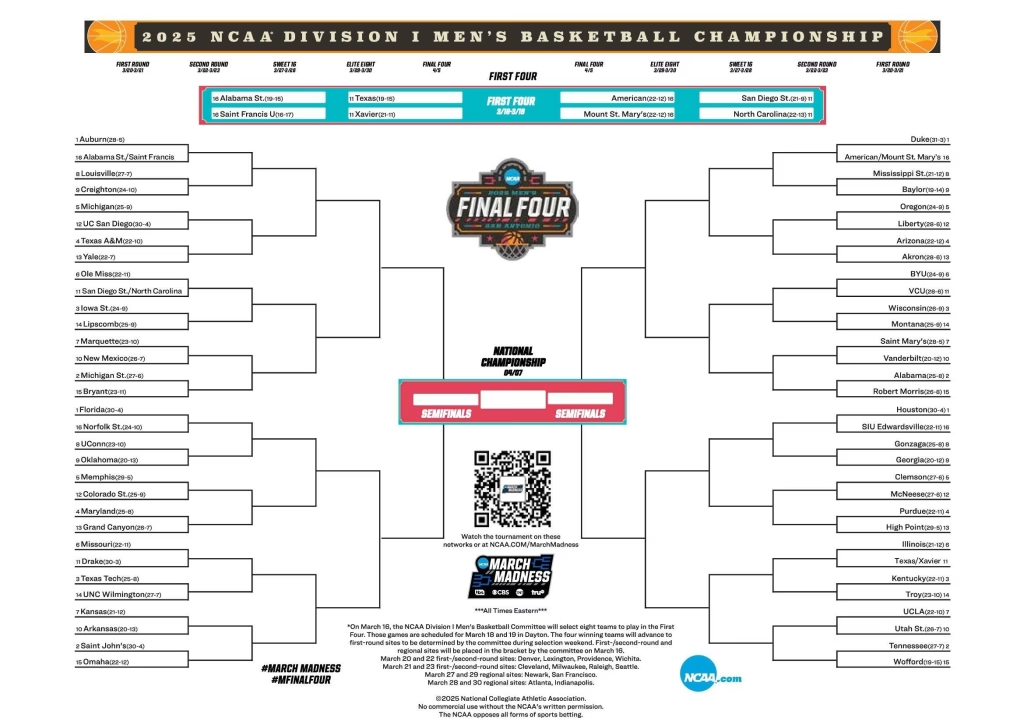
2025 NCAA Tournament Bracket: Every March Madness Team Ranked from Best to Worst

March Madness is here, and the excitement is at an all-time high as the NCAA Tournament bracket is officially set. Every year, college basketball fans eagerly anticipate this moment, ready to fill out their brackets and make predictions. While seeding plays a crucial role in the tournament, this ranking looks at the true strength of each team, evaluating them based on overall season performance, talent, and potential for deep runs.

With 68 teams in the field, surprises and upsets are inevitable. Some lower-ranked teams will shock the nation, while highly regarded programs may falter under pressure. Here’s a comprehensive ranking of all teams in the 2025 NCAA Tournament, breaking down what makes each one special—and which underdogs might be worth keeping an eye on.


How the Rankings Work

Unlike the selection committee’s seeding, these rankings focus on:

  • Overall season performance (win-loss record, key victories, and consistency)
  • Star players and impact performers
  • Strengths and weaknesses on both ends of the court
  • Tournament potential, including the ability to make a deep run or pull off an upset

While the No. 1-ranked team may not necessarily win the championship, this list provides a power ranking based on what each squad has shown throughout the season.


Top 10 Teams Poised for a Championship Run

These teams are the best of the best, with elite talent, balanced rosters, and legitimate national title aspirations.

Duke (No. 1 Seed)

  • The most dominant team in the field, boasting a 31-2 record.
  • Cooper Flagg, a potential National Player of the Year, leads the charge.
  • Top-five rankings in both offensive and defensive efficiency.
  • If healthy, Duke has the talent to cut down the nets in April.

Auburn (No. 2 Seed)

  • A deep, athletic roster with a high ceiling despite late-season struggles.
  • Johni Broome is one of the nation’s top big men.
  • The Tigers need to overcome past tournament disappointments to make a deep run.

Houston (No. 1 Seed)

  • Known for its lockdown defense, holding teams under 50 points on nine occasions.
  • Elite three-point shooting at nearly 40% from deep.
  • Kelvin Sampson’s experience makes Houston a dangerous title contender.

Florida (No. 2 Seed)

  • One of the hottest teams in the country heading into the tournament.
  • Versatile, high-energy team that adapts to different playing styles.
  • Florida’s backcourt trio is among the best in the nation.

St. John’s (No. 3 Seed)

  • Rick Pitino has quickly turned this program into a national powerhouse.
  • Possesses the top-rated defense in the tournament.
  • A strong chance to break a 25-year drought without a tournament win.

Tennessee (No. 2 Seed)

  • A rugged, physical team that thrives on defensive pressure.
  • Zakai Zeigler and Jahmai Mashack lead one of the toughest defensive backcourts.
  • A legitimate Final Four threat if the offense remains consistent.

Alabama (No. 3 Seed)

  • Highest-scoring team in the nation at 91.1 points per game.
  • Offense is lethal, but defense has been inconsistent.
  • If Grant Nelson is fully healthy, Alabama is a serious dark horse.

Michigan State (No. 3 Seed)

  • Tom Izzo’s squad shares the ball well and plays disciplined basketball.
  • One of the worst three-point shooting teams, which could be a problem.
  • If they can get hot offensively, the Spartans could make a deep run.

Texas Tech (No. 4 Seed)

  • A well-balanced squad with elite offensive efficiency.
  • JT Toppin is an All-American-caliber player who can take over games.
  • One of the most underrated teams in the tournament.

Maryland (No. 4 Seed)

  • A stingy defensive team that has been clutch in close games.
  • Freshman Derik Queen is a star in the making.
  • Maryland hasn’t lost a game by more than three points all season.

Mid-Tier Teams with Upset Potential (11-40)

These teams have the talent and experience to pull off surprises in the early rounds, with some capable of making a Cinderella run to the Elite Eight.

  • 11-20: Arizona, Wisconsin, Gonzaga, Kentucky, Clemson, Iowa State, BYU, Louisville, Missouri, Saint Mary’s.
  • 21-30: Purdue, Texas A&M, Kansas, Illinois, Michigan, Ole Miss, Creighton, UCLA, Marquette, Oregon.
  • 31-40: UConn, Baylor, VCU, Mississippi State, New Mexico, Memphis, UC San Diego, Georgia, Colorado State, Oklahoma.

Potential Bracket Busters

  • New Mexico (#35): Fast-paced offense with an explosive guard in Donovan Dent.
  • Drake (#41): Strong mid-major program with a history of pulling upsets.
  • Saint Mary’s (#20): Elite rebounding and a slow-paced, suffocating defense.

Lower-Tier Teams (41-68)

While these teams may not be favored, Cinderella stories happen every year. Watch for low seeds that could shock a higher-ranked opponent.

  • 41-50: Drake, Utah State, Arkansas, Xavier, North Carolina, San Diego State, Vanderbilt, Texas, McNeese, Yale.
  • 51-60: Liberty, Grand Canyon, High Point, UNCW, Troy, Lipscomb, Akron, Robert Morris, Montana, Wofford.
  • 61-68: Bryant, Omaha, Norfolk State, Mount St. Mary’s, SIUE, American, Alabama State, Saint Francis.

Cinderella Watch

  • Grand Canyon (#52): A high-scoring team that can shoot their way to an upset.
  • High Point (#53): Entering the tournament on a 14-game win streak.
  • Saint Francis (#68): A true underdog story, making their first appearance since 1991.

Final Thoughts

March Madness never fails to deliver surprises, heartbreaks, and unforgettable moments. While powerhouses like Duke, Houston, and Auburn have the best chances at a championship, teams ranked in the 30s and 40s could pull off stunning upsets.

The beauty of the NCAA Tournament is its unpredictability. A low-seeded team can suddenly catch fire, and a top-ranked program can fall unexpectedly. That’s what makes this tournament the most exciting postseason in sports.

Bracket season is here—get ready for the madness!

author avatar
thedumbeddown